Action figures are manufactured through a controlled sequence of product definition, 3D modeling, prototype approval, material and tooling decisions, part production, painting, assembly, quality control and packaging. A handmade one-off or 3D-printed display model may stop after sampling. A commercial figure must go further: the approved design has to become a product that can be formed, decorated, assembled and packed consistently across the intended order.
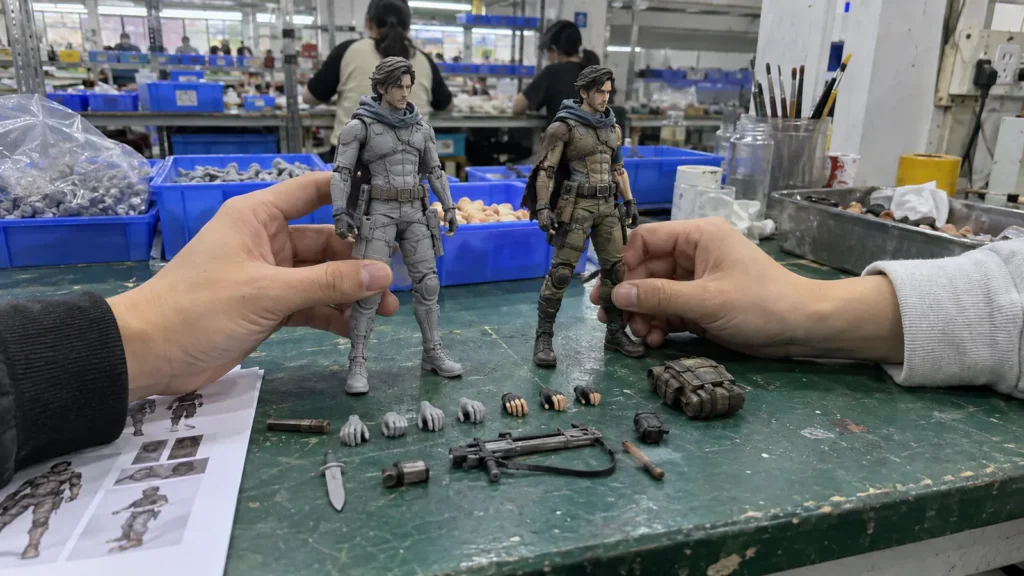
For brands, designers, IP owners and sourcing teams, the important question is also what must be approved before each stage closes. A quick 3D-file change may require a new sample later, affect tooling after that, or create production rework once painting and assembly begin.
The Action Figure Manufacturing Process at a Glance
| Stage | Main Output | Buyer Approval | Next Step |
|---|---|---|---|
| Product brief | Confirmed requirements | Product type, size, quantity, use and target market | Define the development route |
| 3D modeling | Production-minded digital model | Shape, proportion, parts, joints and accessories | Prepare a physical sample |
| Prototype | Physical approval sample | Appearance, fit, movement, surface and dimensions | Freeze the production structure |
| Tooling plan | Material, part and mold plan | Part splits, connections, seams and material direction | Develop tools and trial parts |
| Part production | Molded or otherwise formed parts | Fit, surface, dimensions and function | Confirm decoration standards |
| Color and finish | Decorated approval sample | Color, printing, masking and surface effects | Begin repeat decoration |
| Assembly and QC | Finished production units | Part fit, joints, accessories and appearance | Pack approved goods |
| Packaging | Packed sample and carton plan | Presentation, protection, labels and packing details | Final inspection and shipment preparation |
1. Define the Product Brief
Manufacturing starts with a commercial and technical brief. The factory needs to understand what the buyer plans to sell or distribute before recommending a development route.
- Character artwork, turnarounds, photos, existing 3D files or physical references
- Finished height, scale and key dimensions
- Static, semi-poseable or articulated construction
- Hands, weapons, helmets, bases and other accessories
- Estimated production quantity and repeat-order expectations
- Material preference or required performance
- Color, logo, texture and surface-finish direction
- Retail box, blister, tray, insert or bulk-pack requirements
- Destination market, intended user, inspection needs and target schedule
Define the destination market and intended user early. A display collectible and a product intended for children may require different safety, labeling and testing plans. Confirm applicable requirements with the buyer’s compliance team or a qualified test provider before locking the specification.
Quantity, articulation, material and packaging can change the production method, part separation, assembly plan and quotation basis. Before requesting custom action figure manufacturing, define what the finished product must do and who has authority to approve it.
2. Build and Review the 3D Model
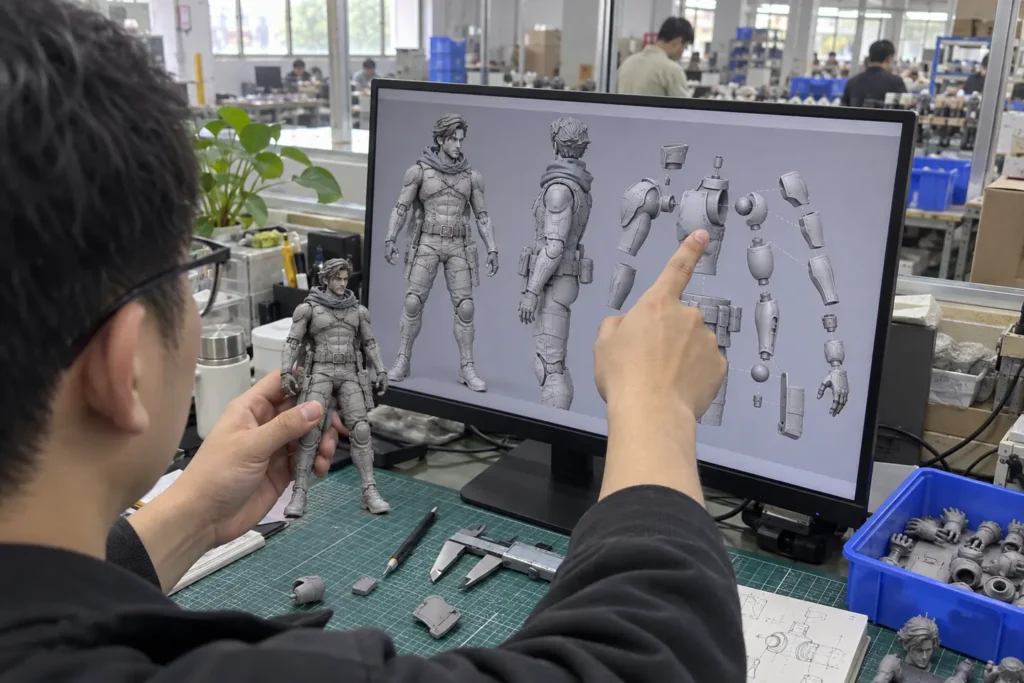
The 3D model translates the visual direction into a structure that can be sampled and prepared for production. An artistic sculpt can communicate the character successfully while still lacking practical part boundaries, connections, joint clearances or suitable detail at the finished scale.
A static display figure can prioritize an uninterrupted silhouette and fixed pose. An articulated figure needs space and clearances for moving parts. Small hands, narrow straps, fine hair tips and tight connections may need adjustment at production size.
Review the major decisions first: height, proportion, expression, costume shapes, pose and accessory scale. Then confirm part splits, visible seams, joint exposure, connection points and areas intended for paint or printing. Projects that begin with sketches, photographs or an appearance-only sculpt may need 3D modeling support before sampling.
3. Produce and Approve a Prototype
A prototype converts digital decisions into a physical approval reference. It may be 3D printed, cast or made through another suitable sample route. Its purpose is to reveal uncertainty before production tooling and repeat decoration.
- Finished size, scale and proportion
- Pose, center of gravity and base stability
- Face, hair, costume and surface detail
- Part separation and assembly logic
- Joint location, range and appearance where applicable
- Accessory fit and hand connections
- Paint, print and molded-color boundaries
- Packaging dimensions and presentation
Prototype approval should identify the exact approved version, its dimensions and any open items. Written comments should distinguish between a model change, a new physical sample and a change to the proposed production structure.
3D printing is valuable for checking form and fit, but it is not automatically the final production method for every project. Quantity, strength, surface expectations, repeatability, finishing and unit economics may support a molded route after the design is validated. Prototype and sample making should reduce uncertainty before tooling begins.
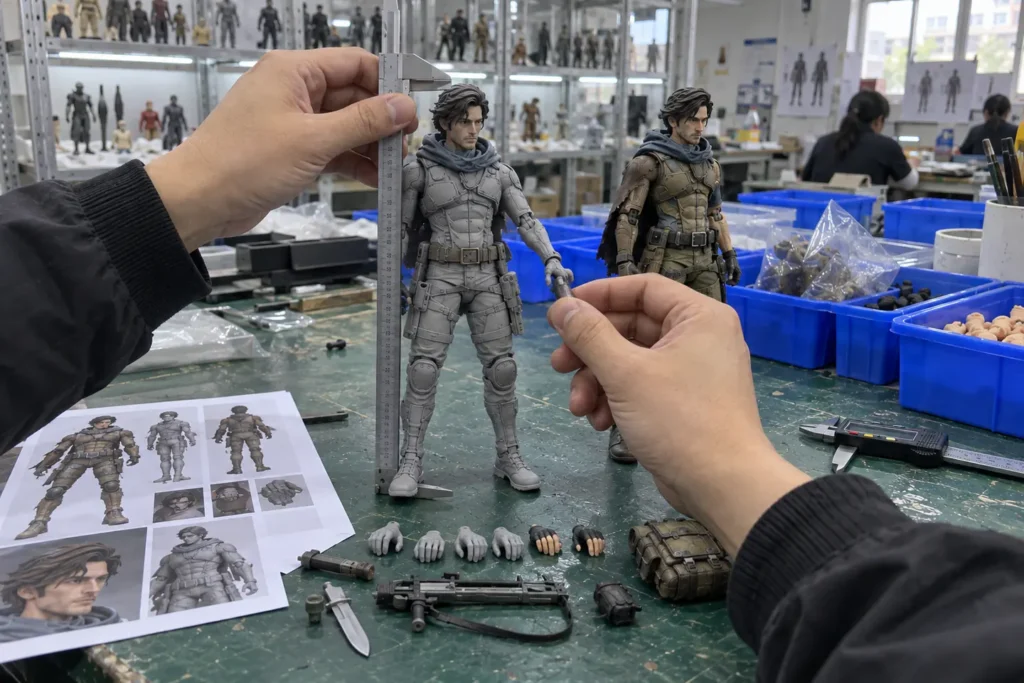
Illustrative Buyer Scenario: Fixing Production Risks Before Tooling
Consider a brand developing a stylized articulated figure with a removable helmet, interchangeable hands and a display base. The artistic sculpt has already been approved, but the production review identifies four issues: a shoulder detail restricts arm movement, a wrist connection leaves too little clearance for finishing and assembly variation, a textured boot crosses the proposed parting area, and several small costume colors would require separate decoration operations.
Before tooling, the model is adjusted without changing the character’s overall look. The shoulder detail is repositioned, the wrist connection is refined, the boot split is moved to a less disruptive area, and one hidden color area is incorporated into the base-color plan. A revised prototype confirms movement, accessory fit and balance. A decorated sample then establishes the face, costume colors and finish reference.
This composite scenario is illustrative rather than a claim about a named FigCrafts client project. It reflects a common production lesson: a good prototype does more than prove appearance. It closes structural and finishing decisions while they can still be changed without modifying production tools or reworking finished goods.
If you already have an approved sculpt or physical sample, request a production review before committing it to tooling.
4. Confirm Materials, Part Splits and Tooling
Once the sample direction is stable, the factory can confirm the production parts and material route. PVC, ABS, vinyl, resin or mixed-material options may be considered according to function, geometry, quantity, finish and assembly. The final choice should follow the specification rather than a generic preference.
| Decision Question | Why It Matters | Buyer Input |
|---|---|---|
| Does the part need to be rigid, flexible or movable? | Affects material direction, connectors and joint design | Product use and functional expectations |
| Which surfaces must remain visually clean? | Affects seams, parting areas and gate placement review | Priority viewing angles and finish standard |
| Which colors can be molded and which require decoration? | Affects part splits, masks, printing and assembly | Artwork, Pantone references and paint map |
| How will accessories connect? | Affects clearances, holding strength and packing | Accessory list and use requirements |
| What quantity and repeatability are required? | Affects whether production tooling is commercially appropriate | Estimated order and repeat-order plan |
Part splits influence seams, color separation, paint masks, pad printing, assembly and inspection. Before action figure mold making, buyers should approve final dimensions, the part list, joint direction, accessory connections, visible seams and surface expectations. Any unresolved feature should be recorded instead of being silently carried into tooling.
5. Develop the Molds and Produce Trial Parts
Production molds translate the approved structure into repeatable components; they do not simply copy a prototype’s exterior. Tooling must account for how each part will form, release, connect, receive its finish and fit during assembly.
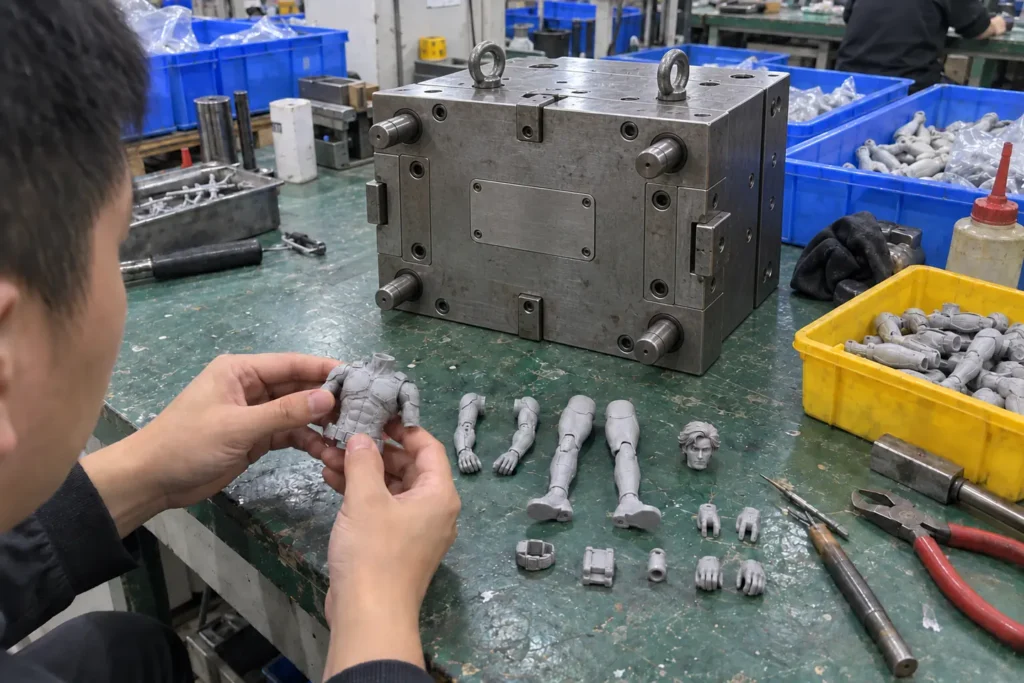
Trial parts are checked for dimensions, surface condition, parting areas, detail reproduction, deformation, connection fit and assembly tolerance. For articulated figures, the review also considers whether joints move and hold as intended. For decorated parts, the team checks whether the surface and part boundaries support the agreed paint and printing route.
If a trial reveals a production problem, the correction and the updated approval reference should be documented. Necessary engineering corrections should not become an opportunity to reopen the entire character design. FigCrafts connects plastic injection molding for figure parts with downstream painting, assembly and inspection after the sample, mold plan and material direction are confirmed.
6. Apply Color and Surface Finishes
Color turns formed parts into the approved character. Depending on the design, the finish may combine molded base colors, spray painting, masks, pad printing, gradients, logos, facial details and matte, gloss, metallic or other approved effects.
Pantone references, approved artwork and physical color samples reduce interpretation. A paint master should define color placement, edges, printed-detail alignment and surface finish. Photographs can support the record, but critical colors need an agreed approval method.
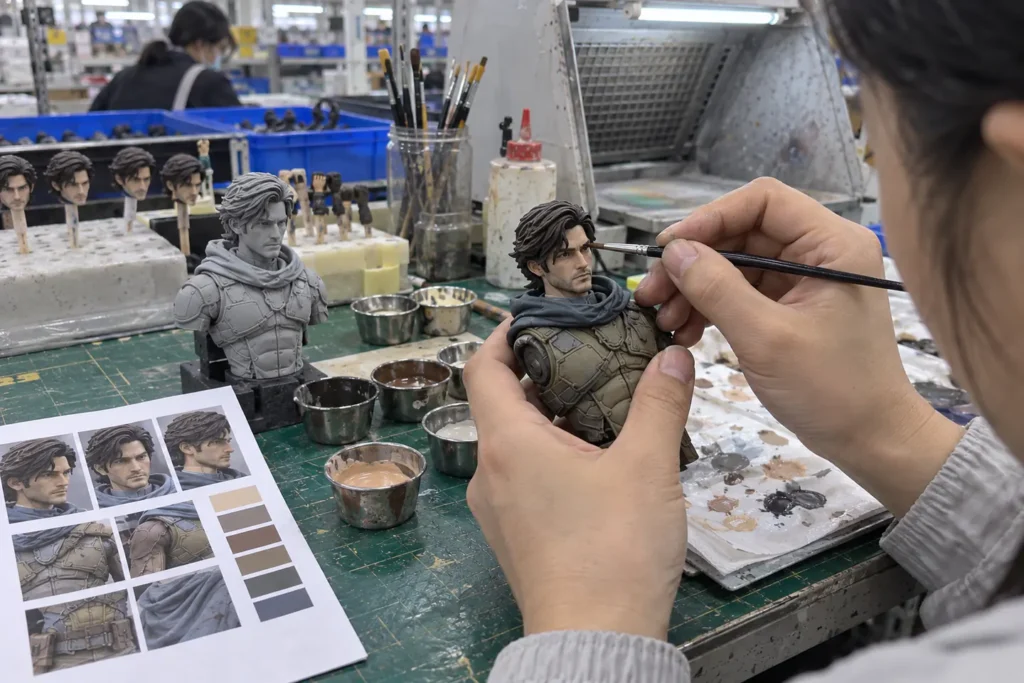
The decoration plan should be reviewed together with the part structure. A visually complex graphic may be practical on one surface and difficult to repeat on another. Changing colors, masks or printed graphics late can also affect packaging photography and the final inspection standard. Review FigCrafts’ painting and pad printing capability when the project includes faces, logos, patterns, gradients or mixed finishes.
7. Assemble and Inspect the Figures
Finished parts are assembled with the required joints, connectors, accessories and bases. A well-painted component can still fail if a seam is excessive, an accessory does not fit, the figure cannot stand as intended, or a joint is too loose or too tight.
- Correct parts and accessory count
- Part fit, alignment and visible gaps
- Joint movement and holding strength where applicable
- Glue marks, scratches, deformation and surface contamination
- Paint placement, printed details and finish consistency
- Standing balance or base connection
- Packaging completeness and product orientation
A display collectible, a poseable action figure and a promotional character product need different inspection priorities. Quality control should use the approved sample, color reference and buyer specification instead of relying on a vague definition of “good quality” after production is complete.
8. Approve Packaging and Prepare Shipment
Packaging development should begin early enough to reflect the final figure, accessory count and sales channel. A blister card, window box, blind box, insert tray or bulk pack creates different structural, artwork and packing requirements.
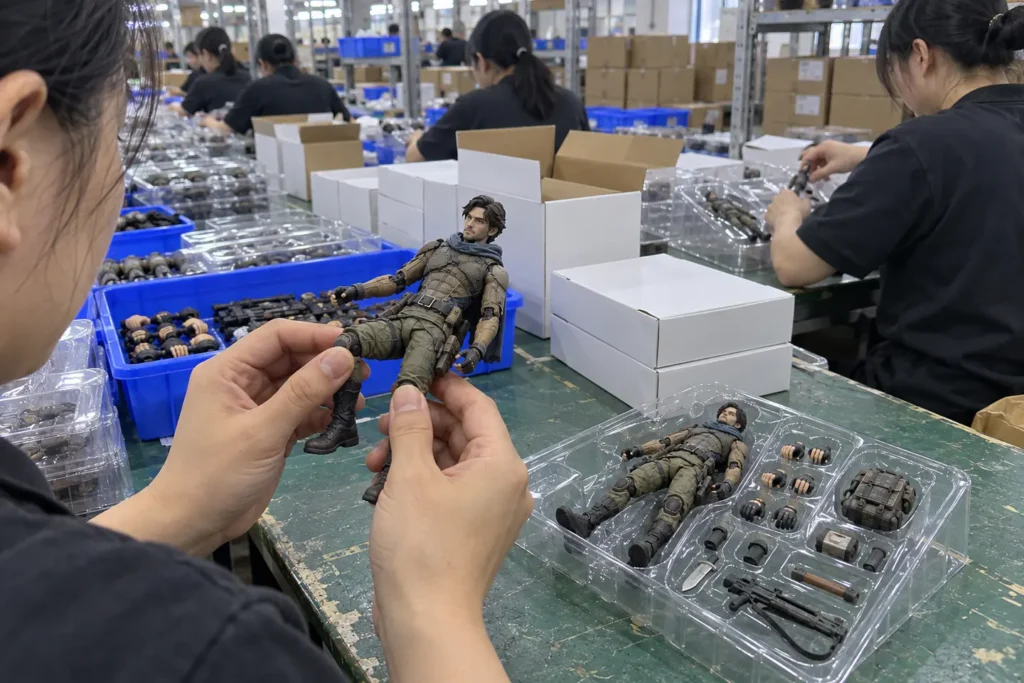
The buyer should approve package dimensions, product orientation, tray or blister fit, artwork, labels, barcodes and carton information. A packed sample can expose movement, pressure and abrasion risks that are not visible when the figure is reviewed on a workbench.
Before shipment preparation, the project should have a finished-goods reference and an agreed inspection scope. Carton configuration and protective packing must match the product and distribution route. FigCrafts’ assembly and packaging support connects finished parts with accessory placement, retail packing and carton preparation.
What Buyers Should Approve at Each Stage
| Approval Gate | Factory Deliverable | Buyer Confirms | Typical Late-Change Impact |
|---|---|---|---|
| Brief approval | Requirements and open-question list | Size, use, quantity, market, features and packaging direction | Usually easier: the route or quotation basis can still be revised |
| 3D model approval | Review model and part proposal | Shape, pose, splits, joints and accessories | Model revision; a new sample may be required |
| Prototype approval | Physical sample and revision record | Appearance, fit, movement, surface and dimensions | Resampling and schedule impact before tooling |
| Tooling approval | Mold plan and trial parts | Parts, connections, material route and tolerances | Tool correction or replacement-part risk |
| Paint master approval | Decorated sample | Colors, masks, printing and finish | New finish samples, setup changes or packaging-artwork impact |
| Production-unit approval | Assembled unit | Fit, joints, accessories, appearance and function | Sorting, repair or production rework risk |
| Packed-sample approval | Retail pack and carton plan | Presentation, protection, labels and packing details | Packaging replacement or repacking risk |
One buyer representative or coordinated team should consolidate feedback at each gate. Conflicting comments from different reviewers make it difficult to identify the final approved version and can trigger avoidable revisions.
Prototype Only or Mass Production?
A prototype-only route fits concept validation, sculpt review, presentation samples and early commercial decisions. A suitable validation run may support internal review, photography, launch planning or market testing.
Production tooling becomes relevant when the buyer needs repeatable molded parts and the project justifies the setup. The decision cannot be made from quantity alone. Part geometry, articulation, durability, surface expectations, color complexity, assembly, packaging and repeat-order potential also affect the route.
Tooling, material, part count, paint operations, accessories, packaging and testing expectations can all affect quotation and schedule. Exact cost, MOQ and lead time should be confirmed only after the factory reviews the actual files and requirements.
Frequently Asked Questions
Can action figures be made from sketches or photos?
Yes. A project can begin with sketches, character sheets, photographs, turnarounds, existing samples or 3D files. The factory needs enough information to understand the form, size, structure and manufacturing goal. Missing views may require additional design or modeling before a sample can be prepared.
Is 3D printing used for the final product?
It can be used for prototypes, approval samples and suitable finished projects. The decision depends on quantity, material performance, strength, surface, repeatability, finishing and cost structure. Many commercial projects use a printed prototype before moving to production molds.
When are production molds needed?
Molds are generally considered after design and sample approval when a project requires repeatable formed parts. The mold plan depends on material, geometry, connections, surface requirements, quantity and the downstream painting and assembly route.
What affects the production timeline?
Design readiness, modeling complexity, sample revisions, articulation, part count, tooling, paint complexity, packaging development, approval speed and order requirements all influence the schedule. A realistic timeline should be prepared after the files and production route are reviewed.
What files should a buyer send?
Send the strongest references available: artwork, front and side views, photos, existing 3D files, dimensions, accessory lists, color direction and packaging requirements. Also state the estimated quantity, destination market and intended use. The custom figure RFQ checklist provides a practical starting point.
Can a factory reproduce an existing licensed character?
A factory should manufacture original designs or characters the buyer is authorized to use. The buyer should confirm ownership, licensing or other applicable production rights before development begins. Reference images can communicate style or construction, but they do not grant permission to reproduce a protected character, logo or product.
Turn an Approved Design Into a Production Plan
Send your artwork or 3D files together with the intended size, quantity, material direction, articulation, finish, accessories, packaging and target schedule. FigCrafts can review what is ready, identify missing production details and recommend the next practical development stage.