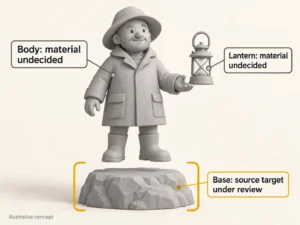

To evaluate recycled or bio-based plastics for custom figures, name the parts covered by your goal and the source claim you want to support. Review the proposed material and its documents alongside what those parts must do in the finished product.
For a figure with a separate base and a removable lantern, your first objective might cover only the base. It still needs to suit the shape, finish and connection. The body, lantern and packaging have their own requirements; evidence about the base’s material does not settle those decisions.
Be precise about content, too. A physical recycled-content claim, a biobased carbon measurement and a mass-balance attribution describe different things. Ask which basis applies, which material or component it covers and what evidence supports it.
You can start this discussion before choosing a material grade. Send the intended use, target market, affected parts and material-source goal, plus any supplier information you already have. Agree who will identify candidates, clarify the documents and define the physical review still needed. Keep any proposed claim within the scope of the evidence you can support.
Define the Material Goal Before Choosing a Grade
Start with a requirement someone can act on. Identify the component, the source attribute you want and the evidence you expect to review. Record the intended product use and target market, including the expected age group.
Material identity and source identity belong in the same discussion. A name such as ABS or polypropylene identifies a material family. It does not identify a complete grade or establish recycled or biobased content. The candidate needs an appropriate material specification and support for its source claim.
Keep the scope visible. A requirement for the base leaves the body, accessory and packaging decisions open. Recycled content documented for a box does not establish the source content of the figure inside.
If the part’s behavior or production route is still undecided, review those questions alongside choosing materials for custom figures. A source preference needs to fit the product you intend to make.
Understand What Each Content Claim Measures
Before comparing percentages, identify what is being counted and which material or product the statement covers. The same number can describe different things when the basis changes.
Physical Recycled Content
A physical recycled-content proposal needs to identify the material, the recovered source and the basis of the stated content. Confirm whether the declaration applies to the supplied grade, a blend or a finished component, and whether its percentage is expressed by weight.
If you require post-consumer content, ask for evidence addressing that source category. A statement about factory regrind does not, by itself, establish a post-consumer source. Keep the supplier’s terminology and supporting basis with the candidate record.
Biobased Carbon Content
The USDA BioPreferred program describes biobased content using new organic carbon as a share of total organic carbon; water and inorganic carbon are excluded. Its certification process uses ASTM D6866 to quantify that attribute. This is a carbon basis, which differs from the material’s share of the figure’s total weight. USDA BioPreferred FAQs.
When you receive a report, record the method and the material or product analyzed. Keep a biobased carbon result on that basis rather than converting it into an unsupported whole-figure mass claim.
Mass-Balance Attribution
ISCC describes mass balance as a chain-of-custody approach that tracks certified inputs and outputs through verifiable records when certified and non-certified materials are mixed. Attribution concerns how the relevant characteristics are assigned to outputs. ISCC’s explanation of mass balance and attribution.
Confirm the applicable scheme, version and statement supported by the supply documents. An attributed share is not automatically a measured physical share in every finished figure. For example, LEGO’s materials statement explains that its mass-balance approach does not guarantee a minimum recycled or renewable content in its products. Keep the proposed wording consistent with the basis that can be demonstrated.
| Claim Basis | What Is Being Stated | Evidence to Ask For | Scope to Confirm |
|---|---|---|---|
| Physical recycled content | Recycled content in a stated material or component | Grade-specific source and content information; applicable traceability evidence | Source category, weight basis, object and proposed supply |
| Biobased carbon content | Biobased carbon relative to the stated carbon denominator | Method, report and identity of the material or product assessed | Carbon basis and analyzed object; no automatic conversion to whole-product mass |
| Mass-balance attribution | Source attributes assigned through the applicable accounting approach | Applicable scheme and supply-chain documentation | Attribution basis, covered supply and supported statement |
Keep the basis attached whenever a percentage is passed between your design, purchasing and marketing teams. A shortened note such as “recycled material approved” can lose the distinctions they still need.
Check What the Grade Documents Actually Cover
Check the producer, exact grade and document version first. A technical data sheet, a source declaration and any applicable certificate can support different requirements. Record what each one actually covers.
NG Nordic’s June 2025 Circo PP 11-1201-TSS Grey data sheet labels its property values as typical rather than specification limits and asks the customer to verify suitability for the intended use. Confirm whether the proposed supply and application fall within the documents’ scope.
Illustrative Buyer Scenario
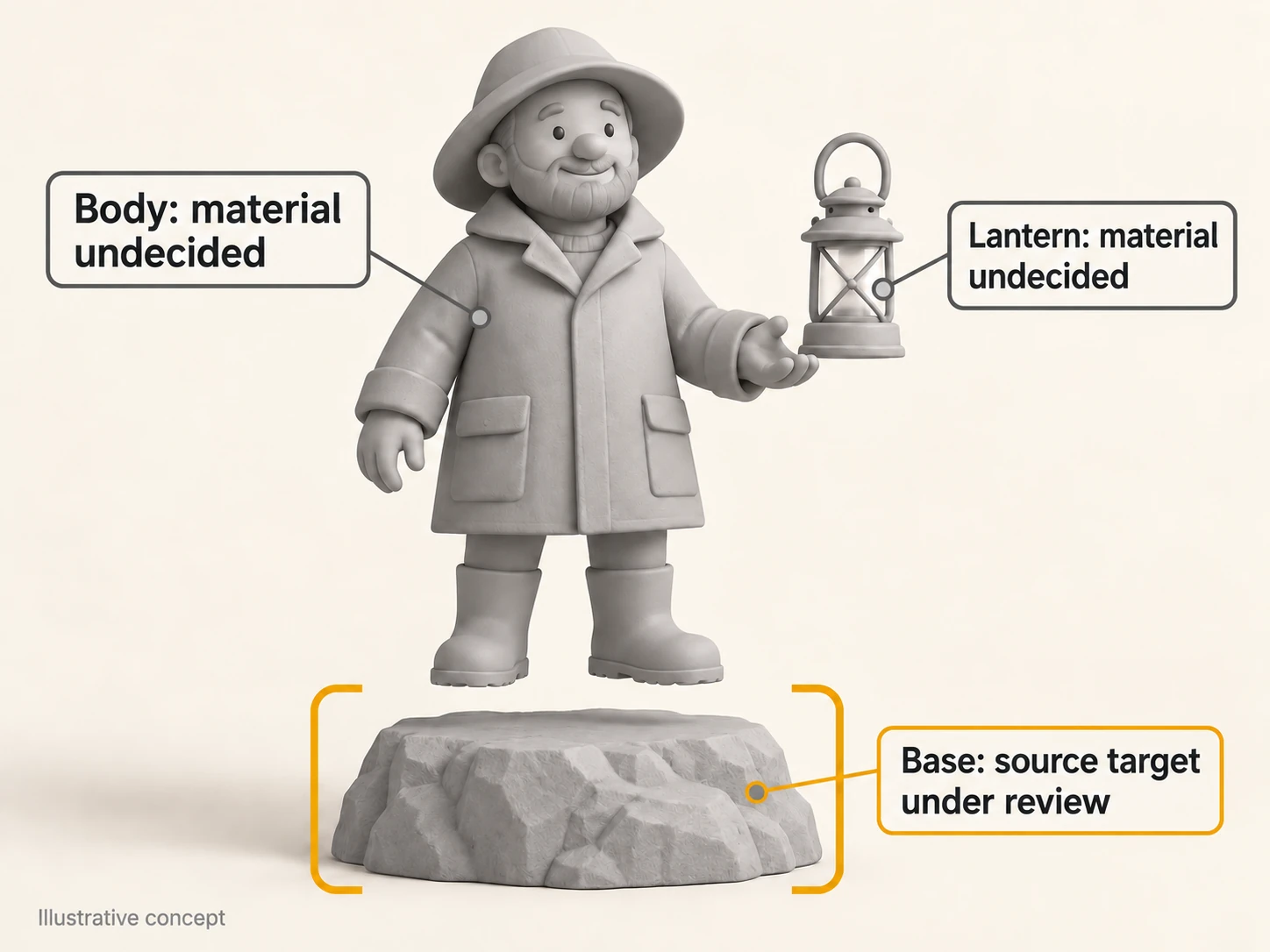
Imagine an original lighthouse-keeper figure. For this fictional design, only the separate rock-shaped base has a physical post-consumer recycled (PCR) content target. The body and removable signal lantern have no source requirement yet; their materials remain undecided. No candidate, content percentage or product-validation result has been agreed.
- Component / Source Goal: Base only; physical PCR content target.
- Proposed Material / Grade Reference: To Be Confirmed.
- Content Basis / Scope / Denominator: Confirm with the candidate supplier; no percentage is specified.
- Document / Version / Issuer / Coverage: To Be Confirmed; ask for documents identifying the requirements they cover.
- Link to Proposed Supply, Where Applicable: Confirm how the supplied material relates to the documents.
- Open Product Validation: Define the review of the actual base, finished surface and body-to-base connection.
- Decision / Responsible Person / Next Action: Open. Agree who will request the candidate information and who will define the part review.
A source claim may be documented while the base’s fit and finish remain unreviewed. Keep those questions attached to the proposed grade when you agree the next step.
Decide Which Figure Parts to Evaluate
For the same fictional lighthouse keeper, carry the source target into the part breakdown. The base is being considered because that is the proposed scope of the brief. Its suitability has not been established, and no particular plastic has been selected.
| Part and Target Scope | Candidate and Source Evidence | Product Evidence Still Needed | Next Action |
|---|---|---|---|
| Rock-shaped base: physical PCR target only; percentage unset | Grade and supporting source evidence to be confirmed | Actual shape, finish, body-to-base connection and assembled stability under agreed conditions | Request candidates and source documents; define the representative part review |
| Body: no source target set | Material undecided; no source claim proposed | Appearance, construction and connection to the base | Confirm the part requirements; assess any later source target separately |
| Removable signal lantern: no source target set | Material undecided; no source claim proposed | Intended removal, retention and finished contact surfaces | Define the handling and connection requirements before accepting a candidate |
Leaving a part outside the current source target does not select its material or prevent a later change. It makes the present decision explicit. If the scope later expands to the body, establish the candidate, evidence and product requirements for that component too.
Keep packaging on its own record. A recycled-content target for an insert or box needs its own supplier information and confirmation; it cannot fill an evidence gap for the base.
Confirm the Candidate on Representative Finished Parts
Choose the physical review around the questions still open. For the base, agree which material, construction, finish and body connection the review must represent. State how the assembled figure is intended to stand and be handled, then define the checks and acceptance requirements with the project team.
A material coupon can support a discussion about a candidate, but it does not contain the base’s geometry or completed connection. Likewise, an appearance model made by another route can answer appearance questions while leaving the intended production material unconfirmed. Keep the sample identity and what it represents in the review record.
Include the finished state where it affects the decision. If a connection is decorated, decide which surfaces must be represented when fit and retention are reviewed. Share the intended use, market and age group with the people defining the assessment.

Agree on the necessary samples, evidence and responsibilities for the actual project. Source documentation and part evaluation can progress alongside each other, with unresolved questions recorded. Use the agreed sample approval scope to distinguish what has been accepted from what still needs checking before proceeding.
Record the Decision and Review Changes
Write the decision against a specific requirement and reference. Accepting source evidence for a stated material does not automatically accept the finished part, every other component or all proposed product wording.
Keep three things clear:
- Confirmed: Identify the object, material or document revision, the requirement addressed and the scope of acceptance.
- Open: Name the missing evidence or unanswered product question, the responsible person and the next action.
- Change Review: Identify which source documents, part conclusions and wording need reconsideration if the proposal changes.
For the fictional base, the record remains: candidate not selected; source evidence to be confirmed; physical review to be defined. The next action is to request candidate information and assign the part-review work. There is no accepted material or production result to report.
Later proposals may change the producer, grade, formulation, source category, color, finish or intended use. Assess which requirements and existing evidence are affected before deciding on further documentation or physical review. Define supply traceability and change handling in the project plan rather than assuming that a familiar material name settles the question.
Keep any intended product statement attached to its evidence and object. If the evidence addresses the base, do not silently broaden that statement to the whole figure or the packaging.
Questions Before You Commit to a Material
Does Bio-Based Mean Biodegradable?
No. Bio-based describes material derived wholly or partly from biological resources. It does not automatically establish biodegradability or compostability, which depend on the material and specified conditions. European Commission definitions.
If either property is a project requirement, ask for evidence addressing the actual material and conditions. Keep that requirement separate from the feedstock description.
Does a Material Certificate Approve the Whole Figure?
Not by itself. Read the certificate’s object and coverage. Evidence about a material’s source does not settle unrelated components, coatings, connections or every applicable product requirement. Relevant component evidence can contribute to the product assessment; its usefulness depends on what it addresses and the conditions under which it applies. Identify the remaining questions before treating the product as approved.
Can We Start Without a Material Grade?
Yes. Begin with the intended product, affected parts, use and market, plus the source goal you want to explore. Send any material information already available and mark the gaps. Agree who will investigate candidates, what information to request and which product questions a candidate must answer. The options and their availability still need project-specific confirmation.
Discuss Your Figure’s Material Target
Send your authorized design, intended size and use, target market, quantity and version breakdown. Identify the parts covered by your material-source goal, and share any candidate-grade details or supporting documents you have. Include the finish, connections, packaging, schedule and current sample status.
FigCrafts can review your project requirements and material direction with you. Specific recycled or bio-based options, availability, source evidence and validation requirements need confirmation for the project.
Explore custom figure project options or discuss your material target.
We work with brand-owned, licensed or otherwise authorized designs. Proof of rights may be requested before production.