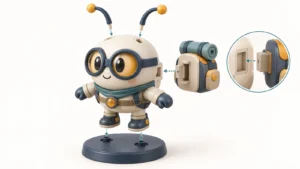

Choose a custom figure’s material around what each part needs to do: hold its shape, flex, move, connect or support the character. Match those needs to a specific formulation, production route and finish. One figure can use more than one material—you don’t have to make its antennae and base do the same job.
Illustrative Buyer Scenario
Picture a round little explorer with goggles, two antennae, a backpack and a separate base. You want the antennae to give a little when touched, the backpack to sit straight, and the character to stand securely. A slightly bendy antenna might be welcome. A wobbly backpack? Probably not.
PVC, ABS, cast resin and soft vinyl are starting points for that conversation, not finished specifications. “Make it in PVC” still leaves the compound, part construction and finished surface to discuss. Vinyl and PVC are related names, and PVC formulations vary with the intended product requirements. Vinyl Institute.
Before committing to tooling, bring the finished size, intended handling and quantity into the discussion. A painted model might settle the explorer’s expression while leaving its antennae and backpack connection unproven. Looking right is one requirement; behaving as intended is another.
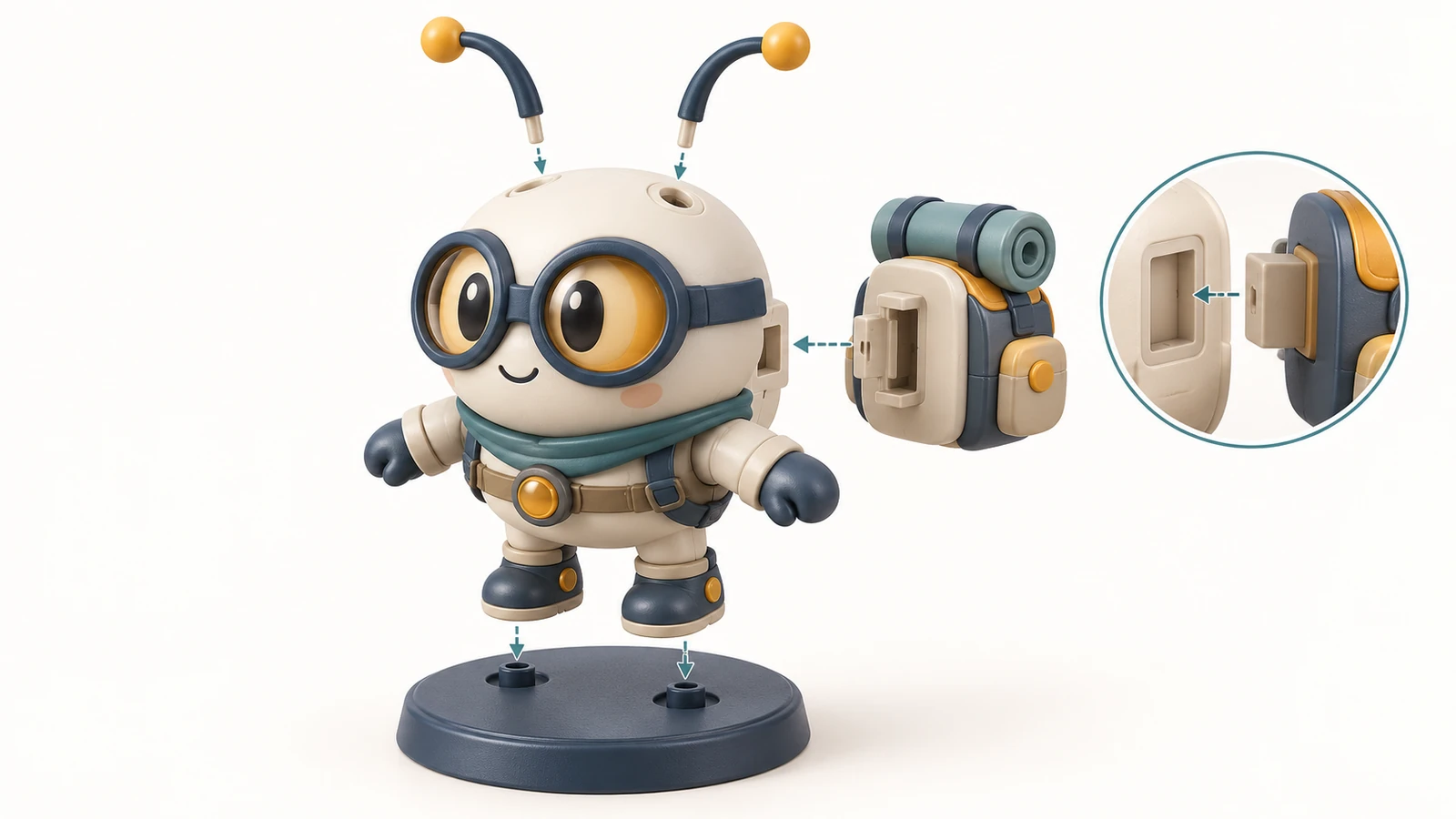
PVC, ABS, Resin and Soft Vinyl: What Are You Comparing?
Material names can sound more precise than they really are. A PVC compound can be formulated for different degrees of flexibility. An ABS grade needs to suit the part’s geometry and use. And “resin” could mean a casting system or a light-curing material for a 3D printer—two different production discussions.
| Material Label | Candidate Use | Route Context | Confirm Before Choosing |
|---|---|---|---|
| PVC | Body parts or features with a specified firmness or flexibility | Injection molding with a suitable compound and part design | Formulation, shape retention, assembly and finish |
| ABS | Rigid accessories, housings or locating features | Injection molding with a suitable grade and tool | Grade, geometry, fit and decorated surface |
| Cast resin | Cast figure parts, display pieces or prototypes | A selected casting system and mold arrangement | Resin system, filled or unfilled formulation, part behavior and finish |
| Soft vinyl | Hollow art-toy bodies or parts intended to have some give | A PVC-based formulation and suitable forming route, such as rotocasting | Formulation, hollow construction, openings, feel and connections |
These are candidate uses, not a ready-made bill of materials. The material still needs to work in the intended part.
For a PVC-versus-ABS decision, start with the required behavior rather than asking which name sounds tougher. ABS is worth discussing for rigid components, but choosing it doesn’t settle the fit or construction. Likewise, a flexible PVC compound doesn’t automatically make a thin feature suitable for bending.
Cast resin deserves the same care. PU casting resin and filled systems sold as polystone aren’t interchangeable specifications. Nor does the word “resin” tell you whether a finished piece must be solid or hollow.
What Does a Material Number Actually Tell You?
Smooth-On reports 20% elongation at break for its Smooth-Cast 65D urethane casting resin, measured using ASTM D638. Its bulletin states that the values were measured after seven days at 23°C / 73°F. This is a published property of one formulation, not a value for all cast resin. Smooth-On technical bulletin.
Don’t read that as permission to stretch a finished antenna by 20%. Elongation at break describes a test specimen reaching failure, not acceptable everyday movement. For your part, ask how much movement is intended, whether it should recover its shape, and how the actual geometry will be checked. The supplier example isn’t a FigCrafts production specification or material recommendation.
What Does Each Part Need to Do?
Start with the part you’re worried about. Is it the hair tip that sticks out, the accessory that keeps falling out, or the base connection supporting a leaning pose? A specific concern gives the factory something to investigate.
| Part | Needed Behavior | Main Concern | Sample Question |
|---|---|---|---|
| Face and body | Preserve expression and silhouette | Lost detail, visible seams or an unsuitable finished surface | Does the finished part match the intended appearance at the actual size? |
| Antennae or thin tips | Allow intended movement without losing the outline | Unwanted deformation or damage during assembly and packing | Does the proposed shape behave as intended under agreed handling conditions? |
| Backpack or rigid accessory | Hold its shape and sit straight | Misalignment or an unsuitable attachment | Does the completed connection hold the part in its intended position? |
| Moving or removable interface | Move or retain an accessory as intended | Fit, friction and contact with decoration | Does it work after the intended finish is applied? |
| Base and support connection | Support the display pose | Instability or an unsuitable support arrangement | Does the assembled figure stand as intended under agreed conditions? |
“Soft” is a good example of a request that needs a little unpacking. Do you mean pleasant to touch, flexible enough for assembly, or able to spring back after a small bend? Those aren’t the same requirement.
For the explorer’s antennae, describe the movement you want while protecting the character’s outline. For its backpack, separate the need for rigidity from the need for a straight, secure connection. If the sample sits crooked, the locating features may need attention; a stiffer material alone won’t answer that question.
Include the intended handling too. A display figure that stays on a shelf and a figure with accessories that users repeatedly remove have different requirements. For articulated action figure production, material selection also needs to fit the planned movement and joint construction.
When Does One Figure Need More Than One Material?
A figure can look like one cohesive character without using the same material everywhere. The explorer’s antennae, backpack and base have different jobs, even if they share a color scheme.
Mixed materials are worth considering when one material direction leaves a particular part poorly suited to its task. They aren’t an upgrade by themselves. Each additional material brings another specification, surface and connection to check.
Pay attention to three things at the joins:
- Position: How does the part locate, and what stops it sitting at the wrong angle?
- Retention: What holds it in place, and is it meant to be permanent, movable or removable?
- Finish: Which surfaces are painted, which touch, and what must remain clear for assembly?
A backpack can look neatly aligned when held against the body by hand. That doesn’t establish how the completed attachment will hold it. Review the actual connection and assembly order, not just the two loose parts.
Matching colors also doesn’t prove that different substrates will finish identically. Compare the intended sheen and visible join on representative completed parts. It’s worth adding another material when it solves a part requirement and the joined assembly works as intended.
Which Production Route Fits the Product?
Choose the route alongside the material, not afterward. The part shape, intended delivery, quantity and surface requirements all belong in that decision. A printed appearance model and a molded production part may look similar while answering different questions.
| Route | Candidate Purpose | Main Preparation | Still to Confirm |
|---|---|---|---|
| 3D printing | Appearance development, selected fit studies or a specified end-use application | Suitable digital geometry, printing material and finishing plan | Which conclusions transfer to the intended production construction |
| Resin casting | Cast parts, display pieces or development samples | Master, mold arrangement and a selected casting system | Part behavior, surface, assembly and the planned production quantity |
| Injection molding | Repeated molded-part production | Material grade, production-ready geometry and tooling | Trial parts, dimensions, finish and completed assembly |
| Soft-vinyl forming / rotocasting | Hollow toy bodies or parts designed for the selected route | Suitable formulation, mold design and opening arrangement | Shape, feel, connections and the finished construction |
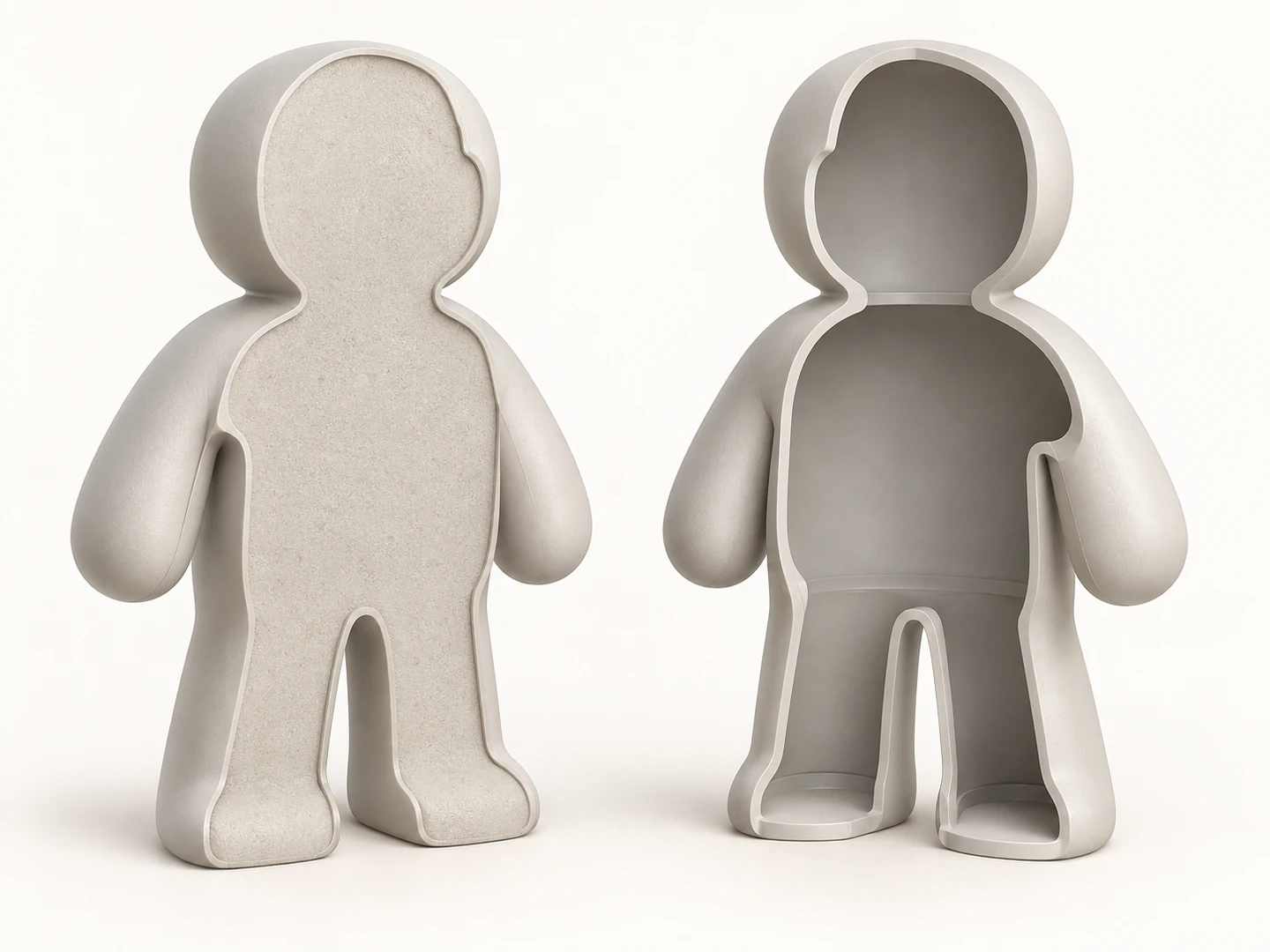
For custom PVC figure production, discuss the compound and part breakdown together. The sculpt still needs a production structure; choosing PVC doesn’t settle where parts separate or how they connect.
For custom vinyl toy production, bring the hollow form and openings into the review early. A hollow body isn’t simply a solid design with its middle removed. Its construction needs to suit the proposed forming and assembly route.
There’s no universal order quantity at which every project should switch processes. Ask the supplier to assess the actual design, number of versions and finishing work. Keep any route comparison tied to the same intended product; otherwise, you may be comparing an unfinished prototype with a decorated, assembled production unit.
What Changes When Quantity or Finish Changes?
The total order is only part of the picture. The factory also needs the quantity for each SKU or colorway, which parts are shared, and which finishes change. A shared body doesn’t necessarily mean every version has the same production requirements.
Be clear about color, too. Is it in the base material, painted on top, or a combination? A new material color and a new painted finish are different changes. Include the intended primer, coating, sheen and decoration boundaries in the review with painting and pad printing.
Illustrative Calculation
Suppose you want to compare two candidate antenna materials across three planned finishes, and intend to review every pairing:
2 material candidates × 3 finishes = 6 material–finish combinations.
That means six configurations to consider, not an instruction to order six samples. The specimen count and checks depend on the agreed project plan. No test result is assumed.
If you’re only reviewing the two candidates in one finish, the scope is different. Tell the supplier which combinations you actually intend to produce, rather than adding every possible pairing to the sample request.
Quantity also affects what the factory can quote and organize. At FigCrafts, prototype and low-volume options can start from one unit using a suitable process. Typical injection-molded production MOQ is 500–1,000 units, depending on tooling, material, part count, variants, finishing and packaging. That isn’t a fixed MOQ for PVC or ABS, or confirmation that every colorway can share the same minimum.
Include the full version breakdown in the production review before treating a material or route as commercially settled.
What Can the Sample Actually Confirm?
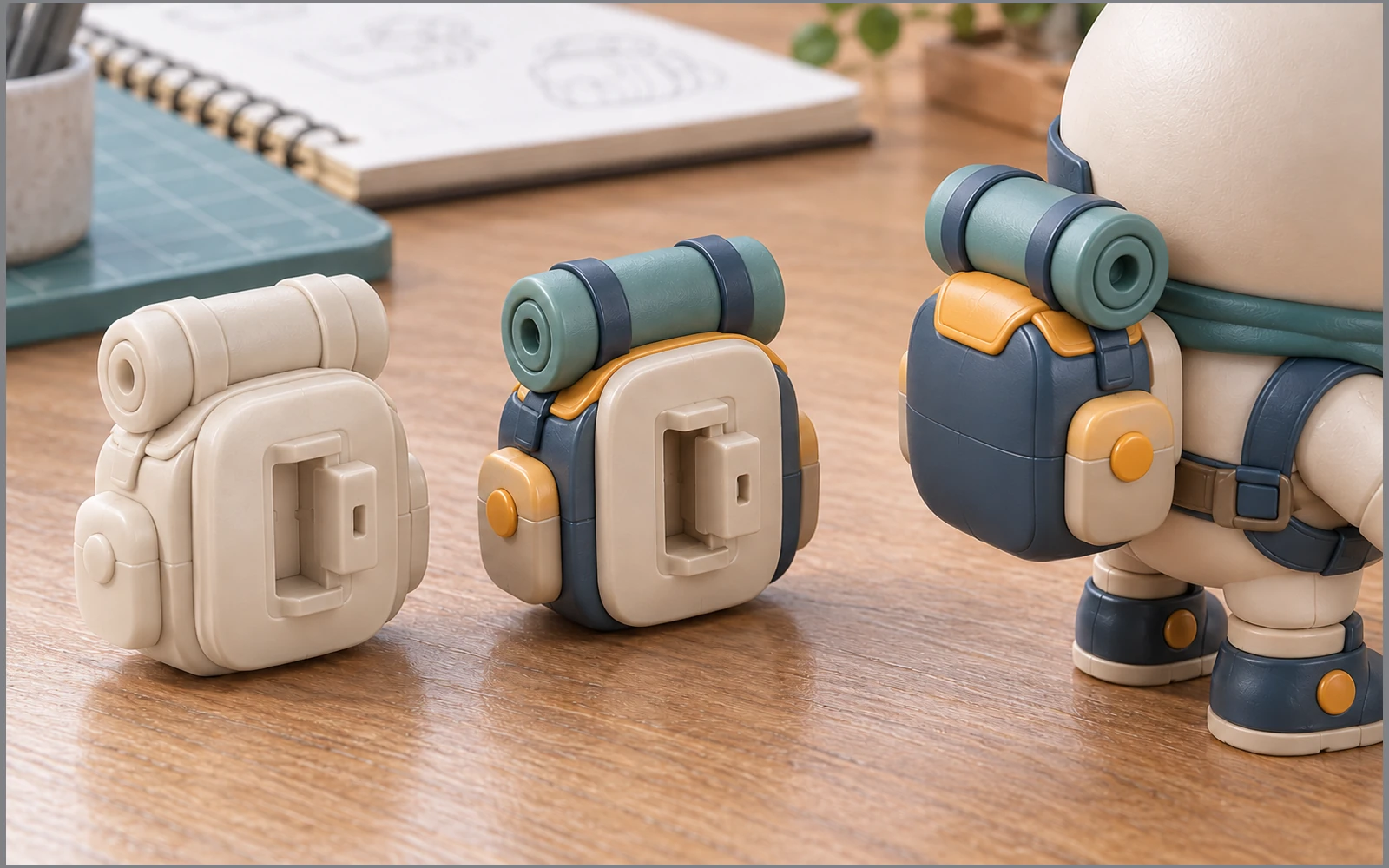
A lovely painted model is worth reviewing—but you still need to know what it’s made from. If it uses a different material or process, it may answer appearance questions without settling production behavior.
- Appearance prototype: Review expression, proportions, silhouette and visible assembly relationships. Don’t assume it establishes the behavior of a different production material.
- Material sample or coupon: Discuss the candidate’s feel or specified properties. A flat piece isn’t the explorer’s long antenna or its backpack connection.
- Representative finished part: Review the proposed material, geometry, decoration and connection together under agreed conditions.
For prototype and sample-making, state which of those questions you need answered. Identify the part revision, material or formulation, process and finish used in the sample.
If the material, shape and attachment all change at once, a different result can’t automatically be credited to the material. Keep track of what changed and what still needs checking. Include packing contact where it matters—for example, whether the proposed arrangement presses against an exposed antenna. A conclusion about the loose part isn’t automatically a conclusion about the packed figure.
How Do You Keep the Approved Material Consistent?
Once a sample is accepted, “use the same plastic” is too vague for a production record. The factory needs to know which plastic, on which part, with which finish and reference sample.
Record the details that matter to the project:
- Part identity: Part name or ID, drawing or sculpt revision, and assigned material.
- Material identity: Supplier and grade, or an agreed internal formulation code with a traceable reference.
- Production construction: Forming route and the geometry or interface conditions that affect the selection.
- Finished appearance: Base color, coating and decoration requirements, plus the approved finish reference.
- Sample and checks: Sample identity, agreed handling or interface conditions, acceptance requirements and any unresolved issues.
- Changes: Which material, supplier, formulation or process changes need review before proceeding.
The record doesn’t have to turn into a laboratory report for every part. It does need to distinguish an agreed requirement from a preference mentioned in an email.
Keep the reference sample and written specification aligned with the project’s quality-control planning. Inspection records and checks should follow the agreed project plan, not an assumed list that accompanies every order.
Material Selection Questions
Are Soft Vinyl Figures Made from PVC?
Soft-vinyl toys commonly use a PVC-based formulation. “Vinyl” and “PVC” aren’t unrelated base materials. The useful distinction is the specific compound, forming route and finished construction—not a simple vinyl-versus-PVC quality ranking. Ask the supplier to identify those details for the proposed toy.
Can a PVC Figure Include ABS Parts?
Yes. Different parts can use different materials if that suits their requirements. A rigid accessory may have different needs from a flexible feature. The materials, connections and decorated assembly still need review together; a mixed-material specification doesn’t prove that the parts will fit or perform as intended.
Is Cast Resin the Same as 3D-Printing Resin?
No. Resin 3D printing uses a light-curing formulation; casting uses a resin system specified for its casting process. Formlabs resin-printing explanation.
A printed model can support design review, but its material behavior doesn’t automatically represent the proposed cast part. Identify the actual system used for each sample.
Can You Change the Material After Tooling?
Sometimes, but it needs review rather than a straight substitution. Injection molds account for the selected resin’s shrinkage; a change can affect the finished dimensions and fit. Protolabs material-selection guidance.
Check the proposed grade against the tool, part requirements and finish, then agree on any further trial or sample work. Don’t assume an unchanged material-family name means an interchangeable formulation.
Request a Production Review
You don’t need to arrive with every material grade decided. Describe the product you want and the parts that concern you. “The antenna should give a little without changing the character’s outline” is a clearer starting point than “use soft plastic.”
Send:
- Design or 3D files, finished size and intended display or handling.
- Total quantity and the breakdown by SKU or colorway.
- Material preferences, if any, and the parts that need to flex, move, stay straight or support weight.
- Color, finish and decoration references, including visible joins.
- Packaging requirements, target market, schedule and current sample status.
FigCrafts can review the part requirements, material direction and sample route with you, including the questions that still need a physical check.
We work with brand-owned, licensed or otherwise authorized designs. Proof of rights may be requested before production.