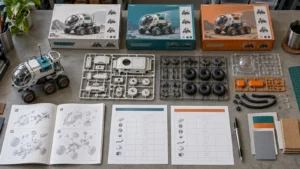
Two suppliers can look at the same model kit and return quotes that seem easy to compare. One has the lower unit price, so it looks like the obvious winner. Then someone on your team asks a simple question: “Does that price include the decals and final packing?”
It does not. Tool trials, instructions, inspection, and a few other items are unclear too. The second quote looks more expensive, but it lists those jobs separately. Suddenly, the cheaper quote is not quite so easy to call cheap.
That is why the first question should not be, “Who gave me the lowest price per kit?” It should be, “Are both suppliers pricing the same product, quantity split, approval work, and delivery scope?”
A model-kit budget usually contains several kinds of cost. Some happen before production, such as engineering review and tooling. Some return with each order, such as setup, molding, decoration, inspection, and packing. Others appear only when you add another color, decal sheet, instruction version, or box. Freight, duties, testing, licensing, and warehousing may sit outside the factory quote altogether.
Once those items are separated, the quotation becomes much easier to read. You can see what you are paying for now, what may be reused later, and why one “small” color variant can become a production job of its own.
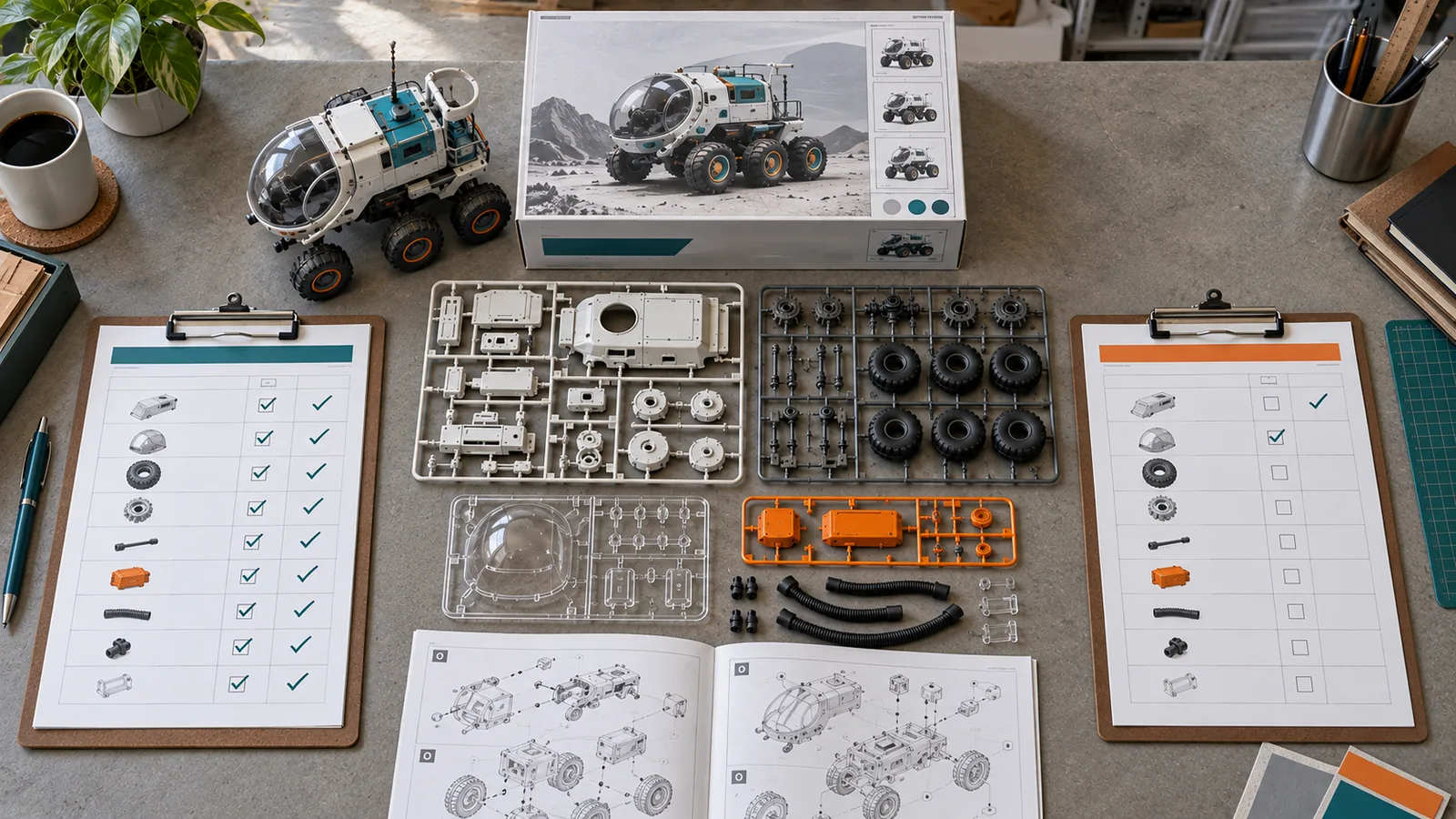
Put Every Supplier on the Same Manufacturing Scope
Before comparing prices, check that every supplier received the same revision and made the same assumptions. A quotation based on an early 3D file is not directly comparable with one based on a released engineering package.
Here is an easy way for the scope to drift. Your concept shows a poseable hatch, but one supplier prices it as a glued part while another assumes a working hinge. Both may believe they understood the request. They are simply pricing two different kits.
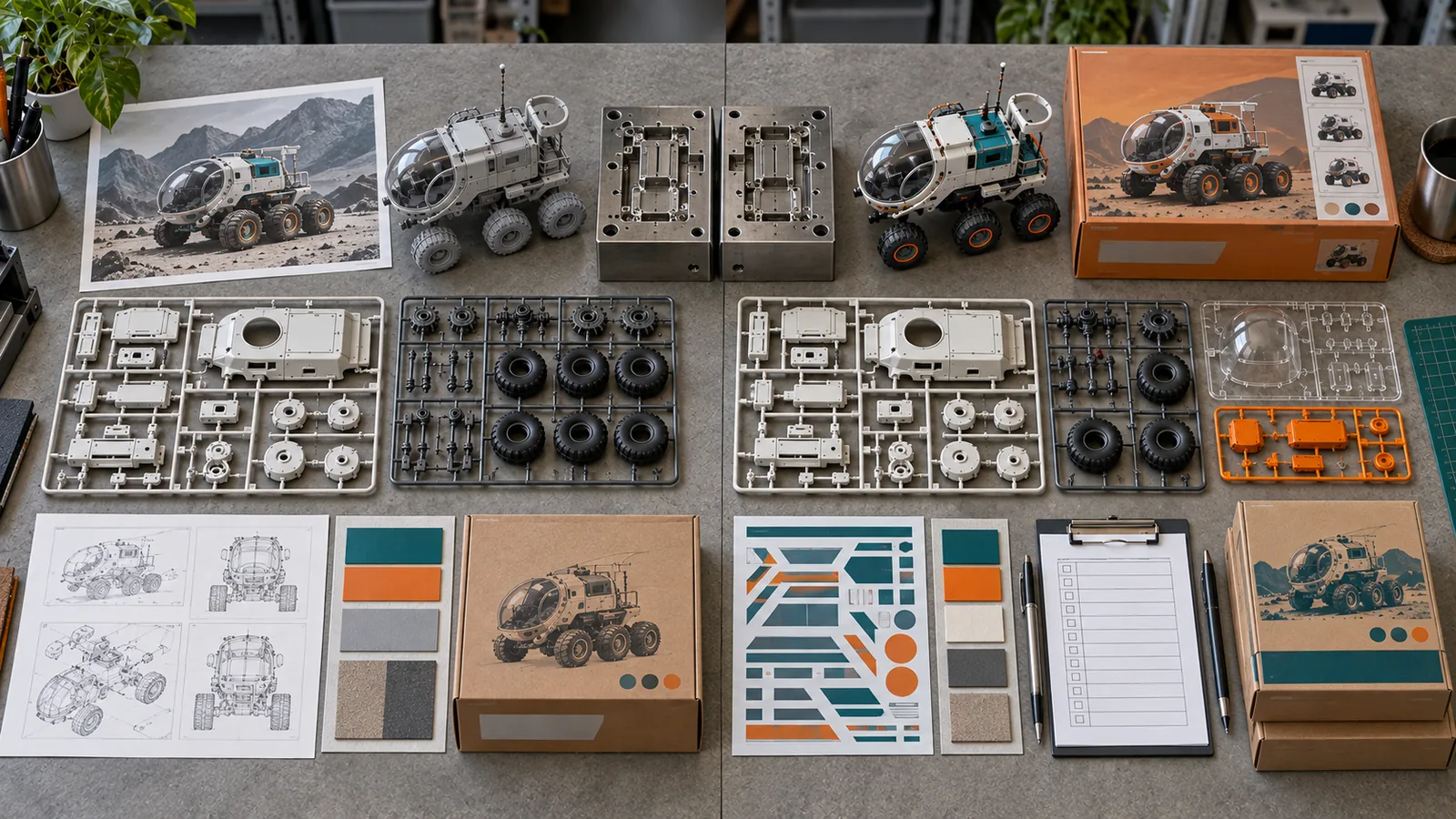
Part count alone is not enough. A kit may combine ordinary molded parts, a clear canopy, flexible hoses, loose accessories, and several runner groups. Two kits with similar part counts can therefore need different tooling, handling, inspection, and packing plans.
Keep These Inputs Consistent When Comparing Quotes
| Input | What Must Match | Why It Changes the Quote |
|---|---|---|
| Design revision | The same approved 2D and 3D files | Geometry changes may affect engineering, tooling, samples, and inspection |
| Size and part scope | Assembled scale, part count, runner groups, loose and special parts | More groups or material types can create additional tooling and setup work |
| Assembly method | Snap-fit, glue, screws, or a mixed route | Fit requirements and assembly labor are not the same |
| Materials and colors | Resin direction, molded-color groups, clear or flexible parts | Each material or color group may need separate purchasing, setup, and validation |
| Decoration | Paint, pad printing, decals, labels, and finish references | Decoration adds artwork, setup, samples, handling, and inspection points |
| Quantity | Total order and quantity per finished SKU | A large total can still contain a very small production or packaging batch |
| Packaging | Bags, trays, instructions, retail box, carton, and pack-out | Different components and versions change purchasing and packing scope |
| Approval scope | Samples, inspection points, records, and release responsibility | A price without the same approval deliverables is not a like-for-like comparison |
| Delivery scope | Delivery term, destination, and included logistics | The factory price and landed project cost answer different questions |
Target market matters too. Packaging language, labels, testing direction, and documents may change by destination. If the file revision, product configuration, or delivery scope differs, you are not pricing the same project.
Which Costs Happen Once, and Which Come Back With Every Order?
The easiest way to make a plastic model kit manufacturing cost understandable is to sort each item by when it occurs. This prevents a one-time investment from being mixed into a recurring unit cost, and it makes repeat-order assumptions easier to test.
For planning—not accounting—the structure can be pictured like this:
Project commitment = one-time work + order setup + (per-kit work × quantity) + variant-specific work + buyer-side costs
The equation does not produce a quotation. It makes missing categories easier to spot.
| Cost Category | Typical Timing | Planning Question |
|---|---|---|
| Development and engineering | Usually before tooling; may return after a design change | Which file reviews, engineering work, prototypes, and revision rounds are included? |
| Production tooling | Before molded production; later correction, repair, or modification may be separate | Which tools, trials, correction rounds, and approval outputs are included? |
| Per-order setup | Each run, color or material change, print process, or packaging setup as applicable | Does the setup apply once per order, once per color, or once per SKU? |
| Per-unit production | Repeats with each kit | Which molded parts, decoration, assembly, inspection, and pack-out are included? |
| Per-SKU or variant work | Changes with colorways, artwork, labels, instructions, or boxes | Which items are genuinely shared across versions? |
| Buyer-side and delivery costs | May sit outside the manufacturing quotation | Who covers licensing, testing, freight, duties, tax, warehousing, and distribution? |
Suppliers may group these lines differently. One quote may combine engineering and samples; another may separate them. Final packing might sit inside the unit price or appear elsewhere.
Ask where each cost belongs and what makes it return. Imagine changing only the retail box from blue to red. The mold stays the same, but the artwork, proof, purchasing, incoming check, and packing reference may not. A repeat order may also reuse geometry while material purchasing, setup, inspection, and pack-out repeat.
This timing view separates the commitment before production from the amount that moves with order quantity.
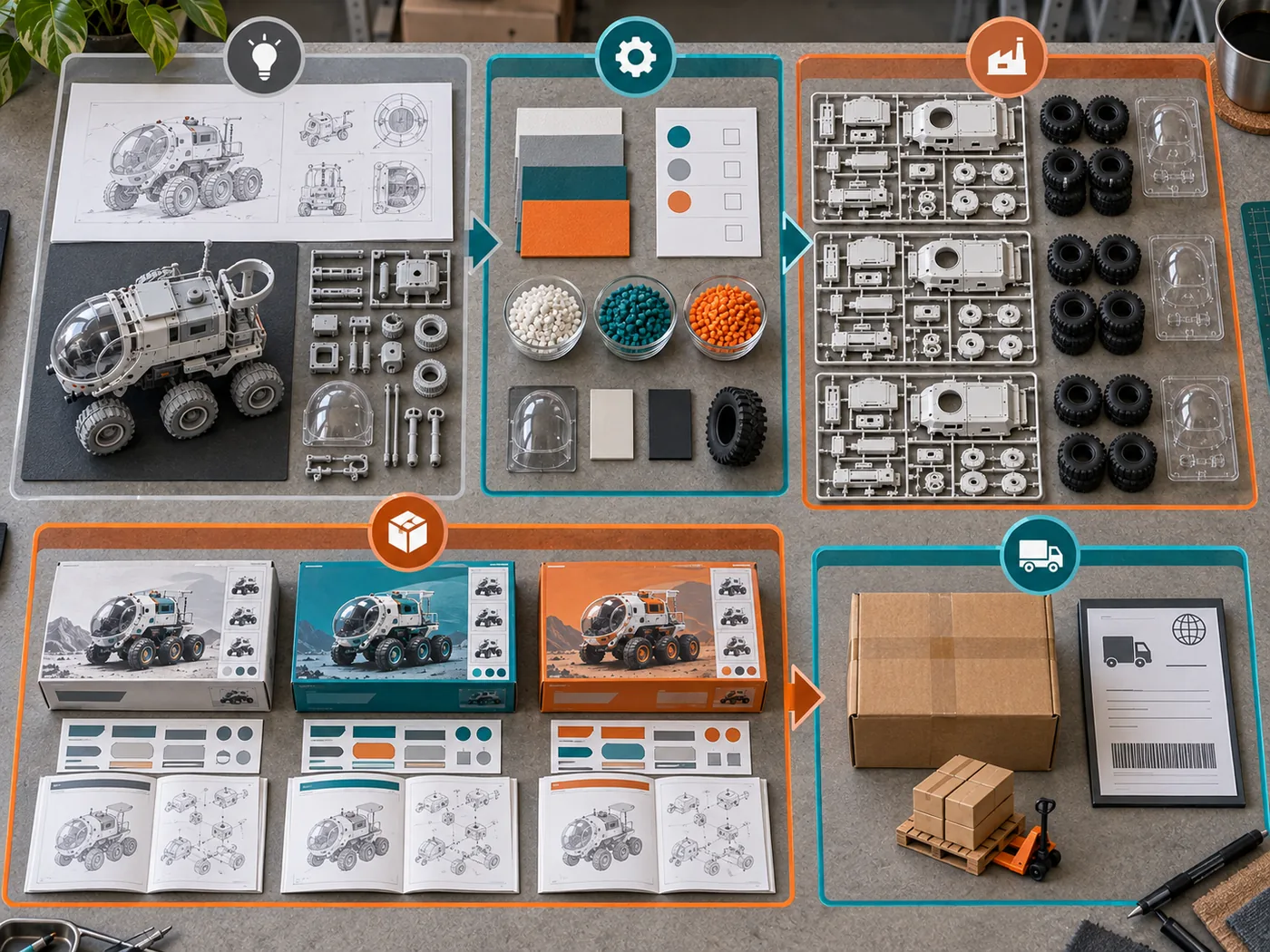
Tooling Matters, but It Is Not the Whole Budget
Tooling is usually the number everyone circles first. That makes sense: it is a visible early commitment. It still needs context. A low tooling figure may describe fewer tools, a different runner plan, another trial scope, or assumptions that have not yet been confirmed.
Part grouping, molded-color separation, clear components, cosmetic surfaces, undercuts, and expected repeat demand can all influence the proposed tooling route. Trial and correction scope matter as well. A tool price that includes a different sample or correction assumption is not directly comparable with another figure simply because both are called “tooling.”
Clarify what is included, what must be approved, and how later changes will be handled. Ownership, storage, maintenance, and transfer conditions also need separate commercial agreement; they should never be guessed from the tooling price alone.
A model kit tooling and mold-making review can connect the product structure, runner plan, trial scope, and approval expectations before the tooling commitment is finalized.
A 1,500-Kit Order Can Still Contain a 200-Kit Problem
A purchase order may say 1,500 kits, but production can contain several smaller groups. The critical number may be the quantity for one molded color, decal, instruction language, or box.
Illustrative Buyer Scenario
The quantities below are simple planning arithmetic. They are not a FigCrafts quotation, production commitment, client order, or MOQ approval.
900 + 400 + 200 = 1,500 kits in total
SKU mix = 60% / 26.7% / 13.3%
| Version | Quantity | Share of Order | What Changes | Questions to Settle Before Quotation |
|---|---|---|---|---|
| SKU A | 900 | 60% | Main molded-color and artwork version | Does this establish the common production and approval baseline? |
| SKU B | 400 | 26.7% | Alternate molded color, decal sheet, and box | Does it require a separate resin/color setup, print setup, sample, or inspection reference? |
| SKU C | 200 | 13.3% | Common base geometry but a different clear runner, label, and instruction version | Can each changed item be produced sensibly at 200 units, or must its batch be planned another way? |
| Total | 1,500 | 100% | Three finished SKUs | Which costs apply once, and which apply to each version? |
SKU C is only 13.3% of the total, yet its clear runner, label, and instructions may each need separate preparation. That does not make the version impractical. It means the split must be visible before anyone treats 1,500 as one uniform run.
The same issue appears in less obvious places. Shared geometry does not remove the need to confirm resin, color changes, purchasing, setup, samples, and inspection references. The box may change while the molded parts stay identical—or the reverse.
Before approving the order plan, separate five numbers:
- total kits in the purchase order;
- kits per finished SKU;
- quantity per resin and molded-color group;
- quantity per decal, print, or label version;
- quantity per instruction and packaging version.
That breakdown prevents a familiar surprise: one supplier prices three setups while another assumes that every component is shared.
If the allocation is flexible, review it before quotation. Moving 100 units may change material purchasing, setup, packaging, or inventory exposure. Whether that improves the plan depends on the kit and injection-molding route.
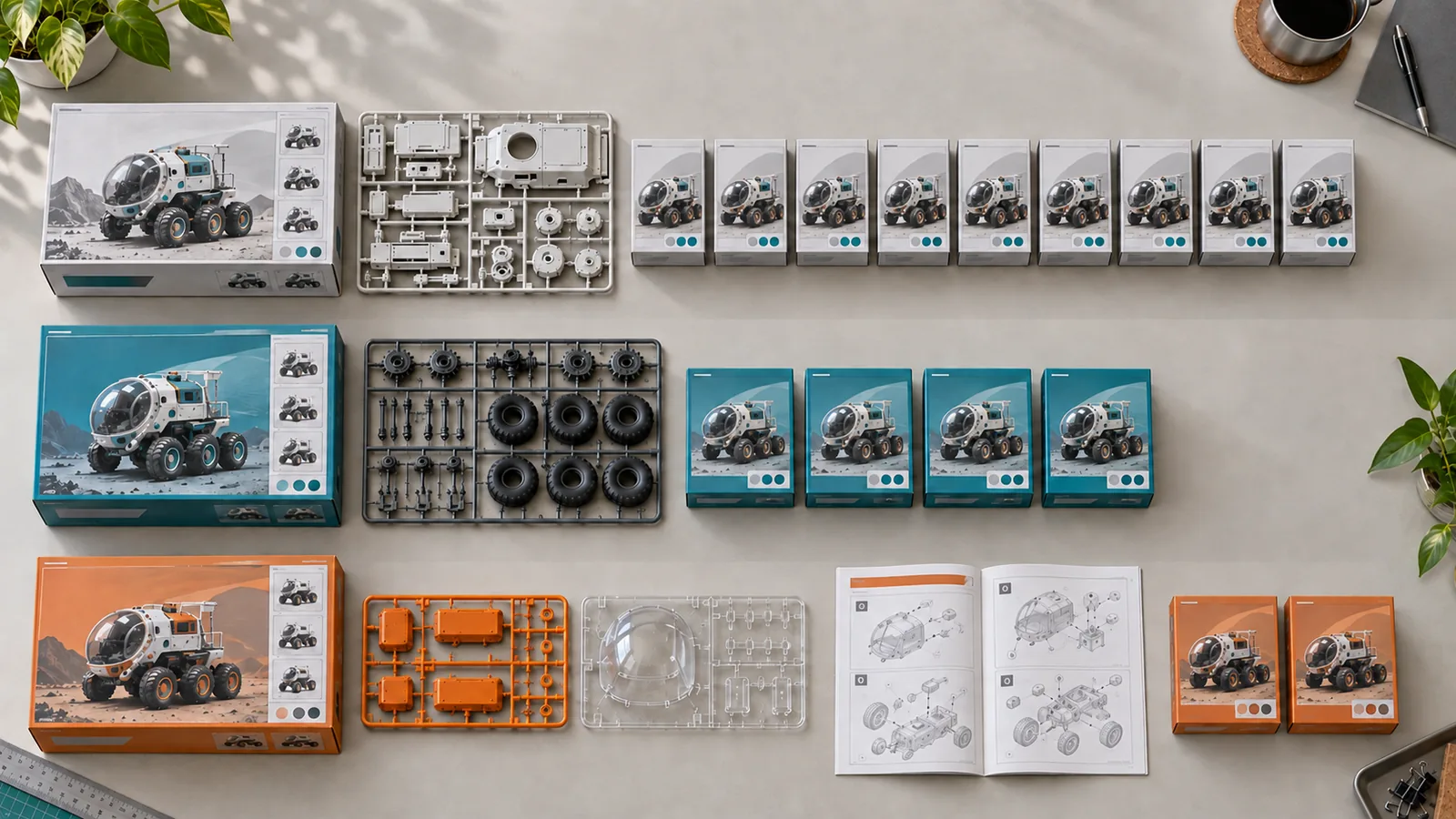
What Changes When You Add a Color Variant or Place a Reorder?
A shared tool can make a model-kit family easier to plan, but it does not make every version identical. Picture the same vehicle kit in olive green and desert tan. The body geometry stays unchanged; the molded color, decal sheet, box, and appearance reference do not.
A repeat order faces similar questions. Is the resin unchanged? Is the color reference current? Has the artwork or target market changed? Does the tool need inspection, maintenance, repair, or modification?
First Order vs Repeat Order
| Item | May Be Reused | Usually Repeats | Needs Confirmation |
|---|---|---|---|
| Geometry and tooling | Released geometry and existing tools | Tool setup and production preparation | Tool availability, condition, maintenance, and any requested modification |
| Resin and molded colors | Approved material and color references | Material purchasing and molding setup | Current specification, availability, and color-match requirement |
| Decoration | Approved artwork and placement references | Printing, painting, decal, or label production | Artwork revision, process, setup, and approval sample |
| Instructions and packaging | Existing dielines and approved artwork | Component purchasing, incoming confirmation, and pack-out | Language, market, barcode, label, carton mark, and artwork changes |
| Inspection | Approved product baseline | Production inspection and release work | Current defect criteria, sampling direction, records, and changed features |
| External requirements | Previous project records | Requirements tied to the new order or market | Whether testing, documentation, or destination requirements have changed |
Repeat orders are not automatically cheaper in every line. Reusable work may avoid starting from zero, while recurring work remains. List unchanged and changed items separately so the supplier can confirm what can be reused and requoted.
How to Put Two Supplier Quotes on the Same Basis
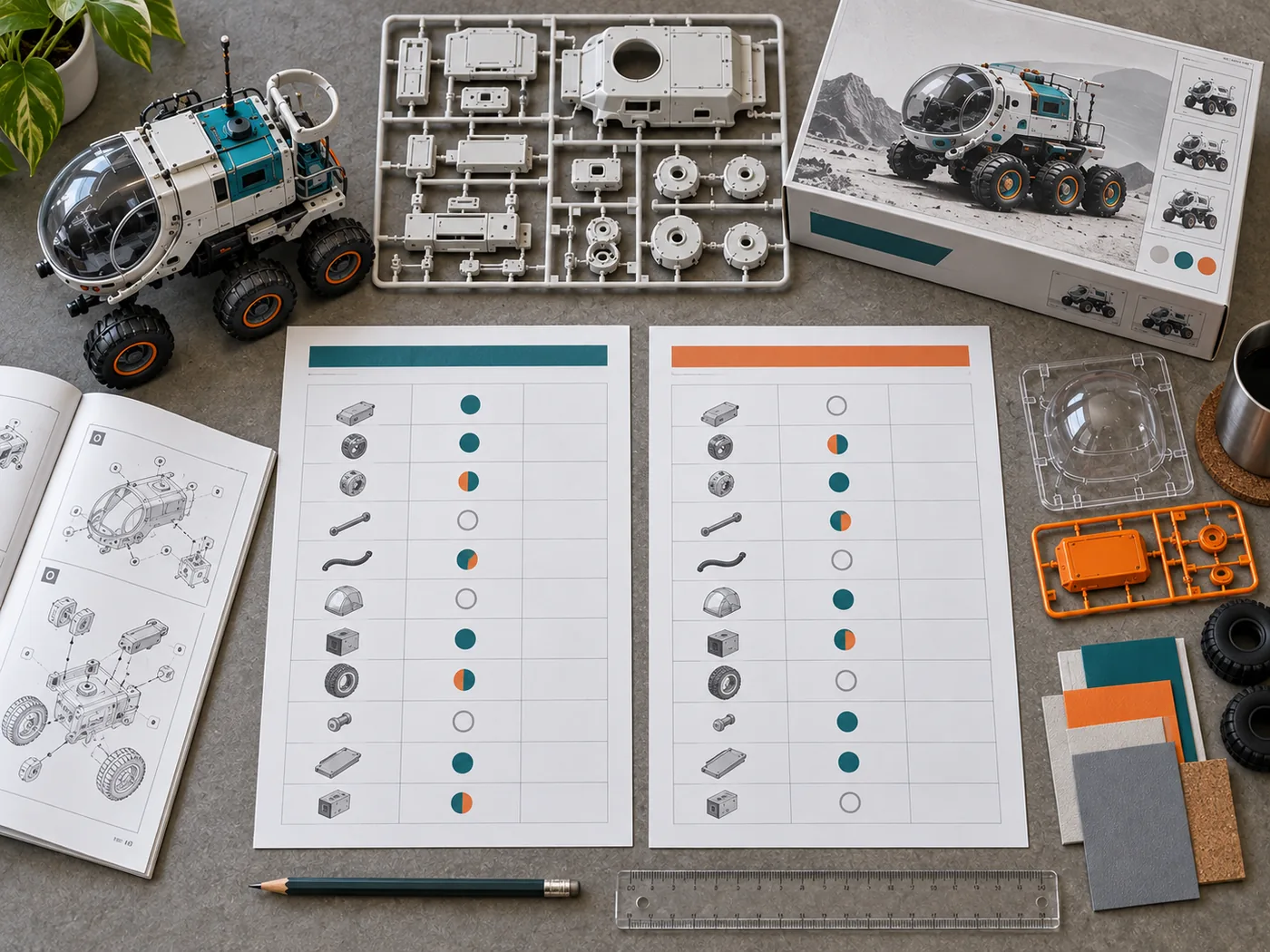
Once the product scope and quantity split are clear, compare the quotations line by line. Empty cells matter just as much as quoted numbers. If Supplier A mentions tool trials and Supplier B does not, do not fill in the blank with optimism. The scope needs clarification.
Use three simple labels while reviewing each line: Matched, Different, and Not stated. A price comparison can wait until the missing assumptions are visible.
Quote Comparison Check
| Question | Supplier A | Supplier B | Difference to Resolve |
|---|---|---|---|
| Which design revision and engineering work are included? | Confirm | Confirm | File or revision mismatch |
| Which tools, trials, samples, and correction assumptions are included? | Confirm | Confirm | Different tooling or approval scope |
| Which resins, molded colors, and runner groups are priced? | Confirm | Confirm | Material or color group omitted |
| Which decoration, decals, labels, and finishes are included? | Confirm | Confirm | Different artwork or process assumption |
| Is quantity stated for every SKU and component version? | Confirm | Confirm | Total quantity hides smaller batches |
| Which instructions, packaging components, and cartons are included? | Confirm | Confirm | Component, artwork, or pack-out gap |
| Which inspection, testing coordination, and records are included? | Confirm | Confirm | Different release evidence |
| What delivery term, destination, freight, duty, and tax assumptions apply? | Confirm | Confirm | Factory and landed scope mixed together |
| What are the payment milestones, quote validity, and change rules? | Confirm | Confirm | Commercial timing or change exposure |
| What terms apply to tool ownership, storage, maintenance, and transfer? | Confirm | Confirm | Separate agreement still needed |
“Sample included” can mean very different things. Confirm the quantity, revision, and whether the sample is for appearance, fit, assembly, decoration, packaging, or production release. A prototype and sample review can connect each sample to its approval decision.
Inspection scope should match too. “QC” alone does not define the product baseline, changed features, inspection points, or release responsibility. Review quality control for model kits with the manufacturing scope.
Resolve exclusions before approving the price. An omitted item rarely disappears; it usually returns later as added cost, schedule pressure, or rework.
Do Not Forget the Costs Outside the Factory Quote
The manufacturing purchase order may be only part of the cash needed to launch the kit. Depending on the project and destination, the buyer may also need to plan for:
- IP licensing, approvals, or artwork clearance;
- market-specific testing or certification coordination;
- freight, insurance, duties, tax, brokerage, and warehousing;
- launch samples, photography, retail content, and distribution;
- buyer-side factory visits or independent inspection;
- local labels or packaging changes after shipment.
These items are not universal exclusions. Confirm what the factory quote includes instead of assuming where the boundary sits.
Packaging needs particularly clear wording. Packaging boxes, instructions, trays, blisters, and related materials are partner-produced. FigCrafts coordinates the project, incoming confirmation, assembly, internal inspection, and final pack-out. A packaging quotation should therefore identify the components, artwork versions, purchasing quantities, approval references, and packing responsibility that apply to the order.
Keep the factory quote and the broader launch budget connected, but do not treat them as the same number. A project can be comfortably inside its manufacturing budget and still be short on freight, launch, or warehouse cash.
Make Every Assumption Visible Before You Approve the Budget
A quotation becomes a useful production baseline when another person can read it and understand what product, quantity, approvals, and delivery scope it covers.
Before approval, confirm that it records:
- the released design revision;
- total quantity and quantity per SKU;
- molded colors, decoration, instructions, labels, and packaging versions;
- tooling, trials, samples, and correction assumptions;
- inspection and approval deliverables;
- included, excluded, optional, and buyer-supplied items;
- delivery term and destination;
- commercial terms requiring separate agreement;
- open technical questions and who will close them.
Do not hide an unresolved assumption inside a unit price. Mark it, assign it, and update the quotation when the answer changes the scope. “We will sort it out later” is rarely a useful budget line.
Frequently Asked Questions About Model Kit Manufacturing Costs
How Much Does It Cost to Manufacture a Plastic Model Kit?
A reliable cost needs a defined design revision, size, part and runner scope, materials, assembly method, decoration, quantity by version, packaging, approval work, and delivery scope. Without those inputs, a generic range may describe a completely different kit. Share the current files and known commercial assumptions so the manufacturer can identify the missing decisions before quotation.
What Usually Makes Model-Kit Tooling More Expensive?
Tooling scope may grow with part grouping, resin and color separation, clear components, cosmetic requirements, undercuts, side actions, cavity strategy, and the expected trial or correction work. The relevant question is not simply how many parts the kit contains, but how those parts must be formed, grouped, released, and validated.
Is the Total Order Quantity the Same as the MOQ for Every Variant?
Not necessarily. The total purchase quantity may be divided across resins, molded colors, finished SKUs, decal versions, labels, instructions, and boxes. Feasibility has to be reviewed against the process and quantity for each changed component or setup. Do not assume that a 1,500-kit order makes every 200-kit variant equally practical.
Are Repeat Orders Always Cheaper Than the First Order?
No. Released geometry, approved references, and available tooling may be reusable, but material purchasing, setup, molding, decoration, inspection, packaging, and shipping still repeat. Changes to artwork, color, material, market, or packaging can add new work. Tool condition and the required production scope should be confirmed for each reorder.
Can Several Color Variants Share the Same Tooling?
They may share tooling when the geometry and tool arrangement remain suitable, but shared tooling does not mean one identical production setup. Different resins, molded colors, decorations, samples, labels, instructions, boxes, and inspection references can still require separate planning and cost.
What Should Two Supplier Quotes Include Before I Compare Them?
Check the design revision, engineering work, tooling and trial scope, materials, runner and color plan, quantities by SKU, decoration, samples, approval outputs, inspection, packaging, delivery terms, exclusions, and change rules. Clarify ownership, storage, maintenance, and transfer terms for tooling separately. Compare the total confirmed scope rather than one isolated unit price.
Request a Plastic Model Kit Production Review
Send your current design files, finished scale, estimated part scope, assembly method, material direction, total quantity, and proposed quantity per version. Include any differences in molded color, decals, labels, instructions, or packaging, along with the target market and delivery destination.
FigCrafts can review the open inputs and help define a suitable development and production route before quotation. Learn more about custom plastic model kit manufacturing or request a production review.